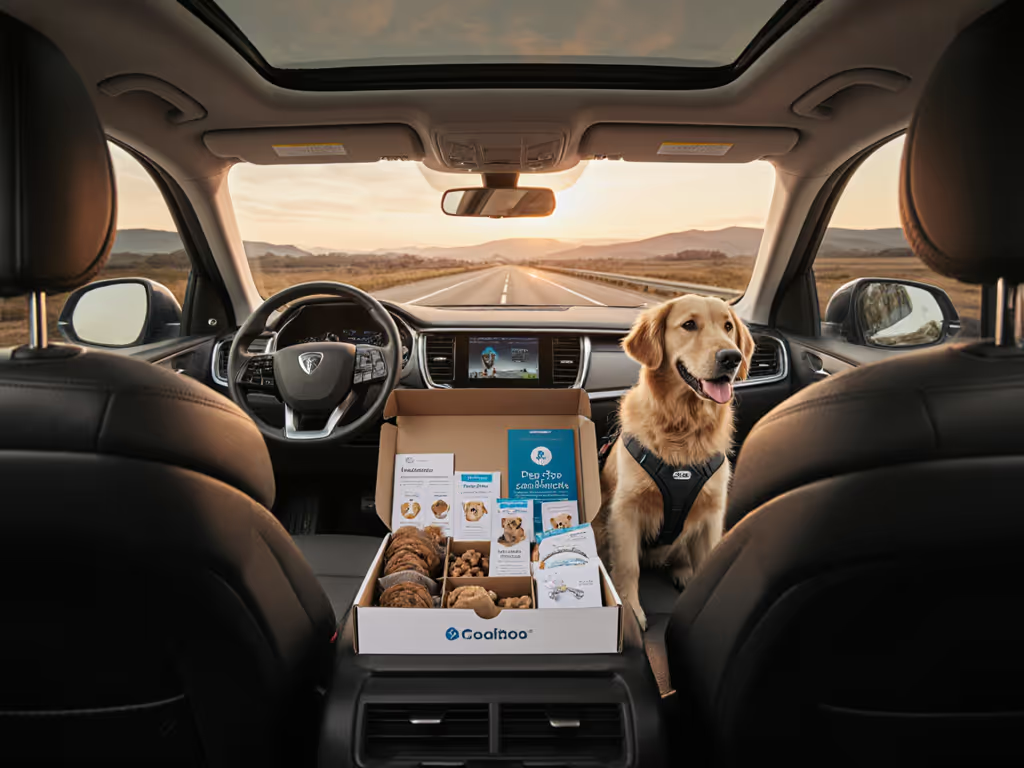
AI Dog Car Safety: Predictive Analytics Guide
By Maya Park • 24th Apr
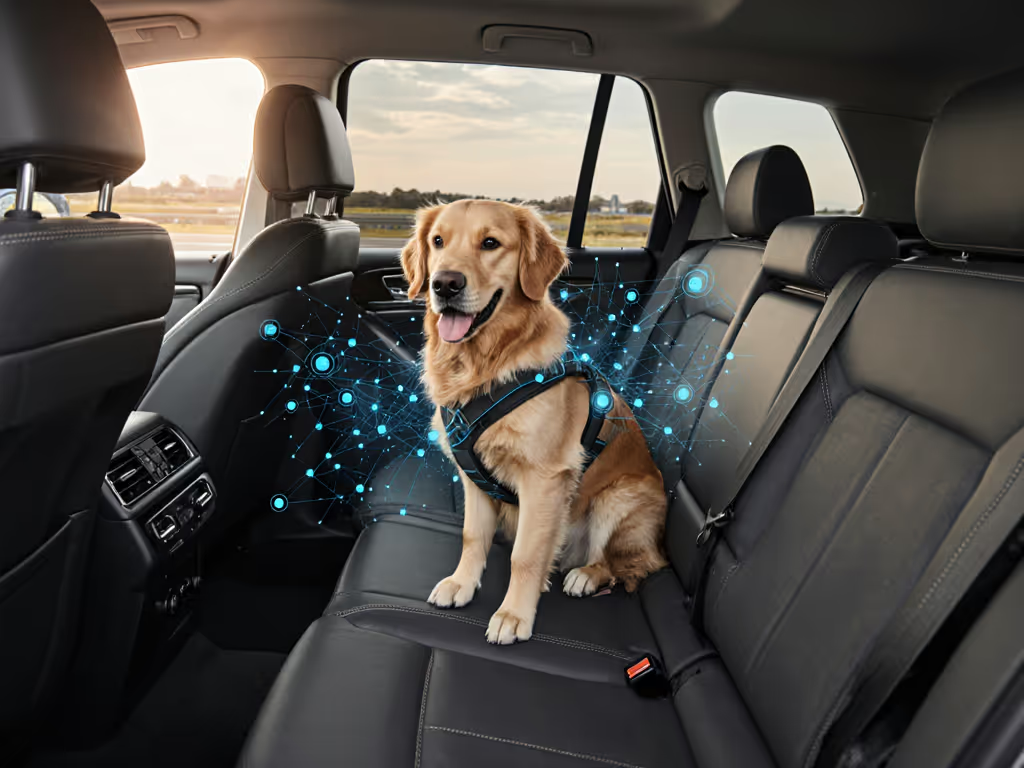
AI dog car safety and predictive pet travel analytics are reshaping how thoughtful dog owners approach vehicle transport. But beyond the buzzwords, what do these tools actually measure, and how can you use data to keep your dog safer during every trip? Let me break down the framework I've tested in real vehicles.
What Do We Mean by "Edge Cases" in Dog Travel, and Why Do They Matter?
In modern automotive safety research, an edge case is a rare, high-risk scenario that falls outside normal operating conditions (like unexpected obstacles on a roadway or unpredictable pedestrian behavior).[1][2] For your dog in your car, equivalent edge cases are equally consequential: a sudden hard stop, a panicked lunge during braking, or a restraint that works on a calm day but fails under real emergency dynamics.
Here's what I've learned after auditing dozens of installations: a setup that feels secure in parking-lot driving often fails the moment tested against real vehicle physics. A dog's mass, behavioral unpredictability, and response to acceleration demand the same measurement-first rigor that safety engineers now apply to detecting rare, dangerous scenarios in complex systems.[2] The physics doesn't care whether you're restraining cargo or a pet.
How Does AI Detect and Prevent Dog Travel Failure?
Advanced safety systems in modern vehicles, whether ADAS (Advanced Driver Assistance Systems) or predictive monitoring, use three fundamental processes:
1. Continuous Data Collection & Anomaly Detection
GPS trackers, activity monitors, and climate sensors log every trip: speed profiles, acceleration patterns, temperature stability, and your dog's movement frequency and intensity. Over dozens of miles, patterns emerge that no single observation reveals. Machine learning models trained on multi-dog travel datasets can identify when your dog's behavior deviates from the established baseline: excessive panting at specific speeds, anxiety spikes at particular times of day, or unusual stillness (which can indicate stress in an anxious dog).
2. Uncertainty Estimation & Expert Review
When an AI system flags an anomaly, it assigns a confidence score. Low confidence signals warrant human expert review; a veterinarian or certified behaviorist can distinguish between normal acclimation and genuine distress, between stretching and anxiety, between panting in a cool car and heat stress. This human-in-the-loop approach mirrors what's now standard in high-stakes AI applications: model uncertainty combined with expert judgment produces more reliable outcomes.[2]
3. Personalized Recommendations & Feedback Loops
Once patterns are verified, the system generates targeted suggestions: optimal tether length to reduce lunge distance, ideal climate thresholds, or (importantly) recognition that your dog needs a fundamentally different containment approach. When new edge cases emerge (a breed-specific predisposition to car sickness at certain speeds, or a restraint design that works for calm dogs but fails for reactive ones), the data feeds back into the model, refining future recommendations.
Recent automotive safety research showed that high-quality human-expert annotations on AI-detected edge cases improved safety performance by 12% and reduced critical close-encounter events by 35%.[2] The same iterative validation applies to dog travel: AI detects, experts contextualize, the system improves.
The Measurement Framework Every Dog Owner Should Verify
Before trusting any AI recommendation or device, understand these core, testable metrics. I audit every one before signing off on an installation:
| Measurement | Why It Matters | Your Test |
|---|---|---|
| Anchor Load Rating | Must withstand kinetic force (often 4-6x body weight during emergency braking) | Pull anchor point with 50-100 lb force; it must not shift |
| Tether Length | Shorter = less slide distance in hard stops; too short = anxiety and neck strain | Measure from collar attachment to anchor; typical range 12-24 inches for small dogs, 18-36 inches for mid-to-large dogs |
| LATCH/ISOFIX Anchor Depth | Surface clips fail under load; structural anchoring is mandatory | Check vehicle manual; confirm anchors extend into floor/structure, not surface-mounted |
| Cargo Crate Stability | Crates slide or tip under acceleration if not secured; hatch slope affects dynamics | Measure cargo floor to hatch peak at 45° angle; test for roll under gentle acceleration |
| Enclosed Climate Control | Temperature inside closed cargo areas spikes 20-30°F above ambient; unsafe thresholds emerge quickly | Monitor enclosed vs. ambient temperature every 5 minutes during transit; safe ceiling is 75°F |
I once pulled hard on a "universal" harness in a dealership lot and watched two buckles pop free. If you're choosing a restraint, compare options in our dog seat belt harness review. Later, a sudden stop on wet pavement proved what measurement verified: our properly anchored setup held completely: zero slide, zero noise, dog remained calm. That single moment crystallized why verification isn't optional.
How Modern Safety Engineering Informs Dog Travel Systems
Leading automotive manufacturers now use a three-phase cycle to improve safety outcomes: simulation and virtual testing, expert annotation and validation, and continuous feedback loops.[4] This framework translates directly to practical dog travel safety.
Phase 1: Test Against Published Standards
Don't wait for real-world failure. Test your restraint setup against published crash acceleration profiles (available from NHTSA and similar agencies) or at minimum perform real emergency maneuvers in an empty parking lot: hard braking, sharp turns at low speed, lane-change simulation. For a deep dive into what 'crash-tested' really means and how to evaluate claims, see our pet restraint crash testing guide.
Phase 2: Expert Vetting
Have your setup reviewed by a veterinarian or certified animal behaviorist, not a product reviewer. They can identify whether your dog's behavior signals genuine distress (requiring a different approach) or normal acclimation (requiring consistency and time).
Phase 3: Iterative Refinement
When you discover a scenario your setup doesn't handle well (a particular road surface that causes sliding, a specific speed at which your dog becomes anxious, a temperature threshold at which panting begins), log it and adjust. Your next trip builds on that data.
Before You Trust Any Recommendation: The Anchor Check
Anchor check: This is where prediction meets physical reality.
Measure twice, anchor once, and your dog rides calmer. Before adopting a predictive AI system or even a simple restraint, verify your vehicle's anchor infrastructure:
- LATCH anchor points: Confirm they're rated for passenger restraint (not cargo-only). Pull with moderate force; immobility is the only acceptable result.
- Cargo tie-down loops: Measure how deep they anchor. Surface clips fail; structural integration is mandatory. Typical spacing: 12-18 inches for balanced load distribution.
- Seat-back angle: Measure where a harness or tether routes relative to the seat back. A 90° pull (perpendicular to seat) is far more stable than shallow 30-45° angles, which slip under load.
An AI system can factor in your vehicle's geometry only if your anchor points are genuine and verified. Understand how airbags, seat belts, and LATCH interact with pet restraints in our airbag-compatible setup guide. Unconfirmed anchors mean unreliable data, which means unreliable recommendations.
Starting Your Predictive Pet Travel Practice
Step 1: Establish Baseline Data Log 3-4 weeks of routine travel: distance, duration, your dog's behavior patterns, stress signals. A simple spreadsheet or existing activity tracker works.
Step 2: Document Specifics Provide your vehicle make, model, year, trim, seat configuration, and dog weight, breed, and age to any AI tool. Specificity eliminates mismatched recommendations.
Step 3: Physical Verification First Hard braking in an empty parking lot. Sharp turns at low speed. Real emergency maneuvers. Never rely on AI predictions without first confirming your setup stays put under actual vehicle dynamics.
Step 4: Select Monitoring Aligned with Your Priorities Climate tracking if your dog spends time in parked vehicles. For hot-weather setups and temperature control, see our dog car cooling comparison. Movement sensors if anxiety is a factor. GPS and activity data for long-distance travel. AI insights are only useful when grounded in measurement that matters to your situation.
Step 5: Close the Loop When you discover an edge case (a scenario your current setup doesn't handle), adjust it. Your next trip benefits from that learning. This iterative cycle is how safety systems actually improve.
Further Exploration
As AI tools and predictive analytics mature in the pet travel industry, look for manufacturers and services offering transparent measurement data, real-world installation guidance, and clear documentation of how their systems handle edge cases. Your dog's safety, like any system safety, is built on specificity, verification, and the disciplined habit of measuring before claiming reliability. The future of dog car safety isn't about passive monitoring or marketing claims, it's about data-driven rigor applied to every anchor, every tether, and every trip.
Related Articles